Friday, December 11, 2009

WP3: Final Draft

Author's Note:

In the third writing project of the semester we were asked to analyze sculptures in the Sheldon Art Museum’s Sculpture Garden. This was different from our previous two writing assignments because instead of a picture, we were examining a three dimensional art object. I felt like this made the assignment much more challenging. It was easy to pick out the rhetorical elements that the sculpture had because of the practice from writing project one and two. However, deciding on an argument that these elements supported was not. I found it rather frustrating when I didn’t have a clear direction of where I was going to go with my paper after the second day of writing about our sculptures. I decided to go over all my notes I had written about Arietta II during class time as well as the pre-writing exercises I had completed. There was one word that stuck out to me in the section I had written about the composition: teamwork. I had not initially meant anything important by this observation, but I realized it not only was a key element in the composition of the sculpture, but also an important aspect in today’s society. This was exactly what I decided to argue in my final writing project, the importance of teamwork.

I made a few changes form my first draft to my final submission of writing project three. The first and probably most significant change a made was moving my second to last paragraph up to the position after the introduction paragraph. Instead of an introduction to the closing, the paragraph “Arietta is an Italian word that means a relatively uncomplicated aria…” was instead, a bridge between my introduction and my body. I felt like this change helped the flow of my essay. It was also a better use of the paragraph because I had just introduced the sculpture and its name, Arietta II, so it made more sense for the paragraph explaining the name’s meaning to be located here. This meant I had to change the transitions in this paragraph and the one that fallowed. I added the last sentence in the title meaning paragraph to: “In the same manor that notes compose a song, every individual bird works together to create a structure that is aesthetically pleasing to the eye.” My next paragraph dealt with the structure of Arietta II so I felt like this sentence would be a good transition.

I also added a video into my essay, Starling in Otmoor, I thought this video was a perfect example of teamwork and also incorporated birds, which is what the sculpture is made of. The video told the viewer that the birds behave in this manor to protect themselves against predators, thus showing the teamwork amongst them. This was the first time I had ever included a form of multimedia other than pictures. I had always wanted to include a video but I never found one that I felt added much to the piece of writing like this one did so I was very happy with that.

The final change I made was in my conclusion. I added the sentences, “Think about all the championship games that have been won, all the magnificent buildings and skyscrapers that have been built and all the ideas that have been turned into realities. Where would the world be without teamwork? I think it is safe to say it would be a totally different place, and one that I don't think I would care to live in.” I think this helped answer the what if? question better and brought the essay to more of a clear end.

This third writing project was more challenging because of the genre of art we had to analyze. There were more things to take into consideration like the location and the material that it was made of that we did not have to consider in the previous writing assignments. Despite these challenges, I think I was still able to compose good argumentive piece that still left my audience with the freedom to form their own opinion.

Links:

First Rough Draft
Statement of Purpose

Final Draft:
Teamwork is concept I was introduced to at a young age. Whether it was picking up toys with my sisters or playing a round of kickball with the neighborhood kids, some form of teamwork was there. As time went on and I got older, I was faced with new circumstances and challenges, but teamwork was one aspect that remained the same. I was on sports teams, dance team and in different organizations. Each one of these activities required me to work with the other members of my group to reach an end goal. Now that I am in college I still have to use these skills when collaborating efforts for a group project or presentation or at my job. As I was looking at the sculpture, Arietta II, designed by Catherine Ferguson, it continuously reminded me of this idea of teamwork. As I thought about the piece of art and the rhetorical elements that it possesses, I recalled the saying, “You’re only as strong as your weakest player.” Observing this sculpture through an aesthetic point of view, the materials that provide the structure of the sculpture, the visual hierarchy in the composition of its individual parts and its location on UNL City Campus all provide evidence that support the importance of teamwork and this commonly used statement. Along with these key rhetorical elements, the name of the art object also ties in with this argument.

Arietta is an Italian word that means a relatively uncomplicated aria. An aria is an elaborate song for a solo voice (thefreedictionary.com). In other words, an arietta is an uncomplicated song that is meant to be sung by one single person. This may not seem like it has much to do with teamwork, but if you consider what makes up a song it actually does. A song is comprised of different notes. Each note has its role in producing the piece of music. If a note is left out, there could be a break in the song or it could cause problems with the balance or harmony in the musical composition. Like the title suggests, this sculpture could be thought of as its own musical piece. Each bird could symbolize a note. Just as a single note in a song, without one of them, the piece could not be considered whole. In the same manor that notes compose a song, every individual bird works together to create a structure that is aesthetically pleasing to the eye.

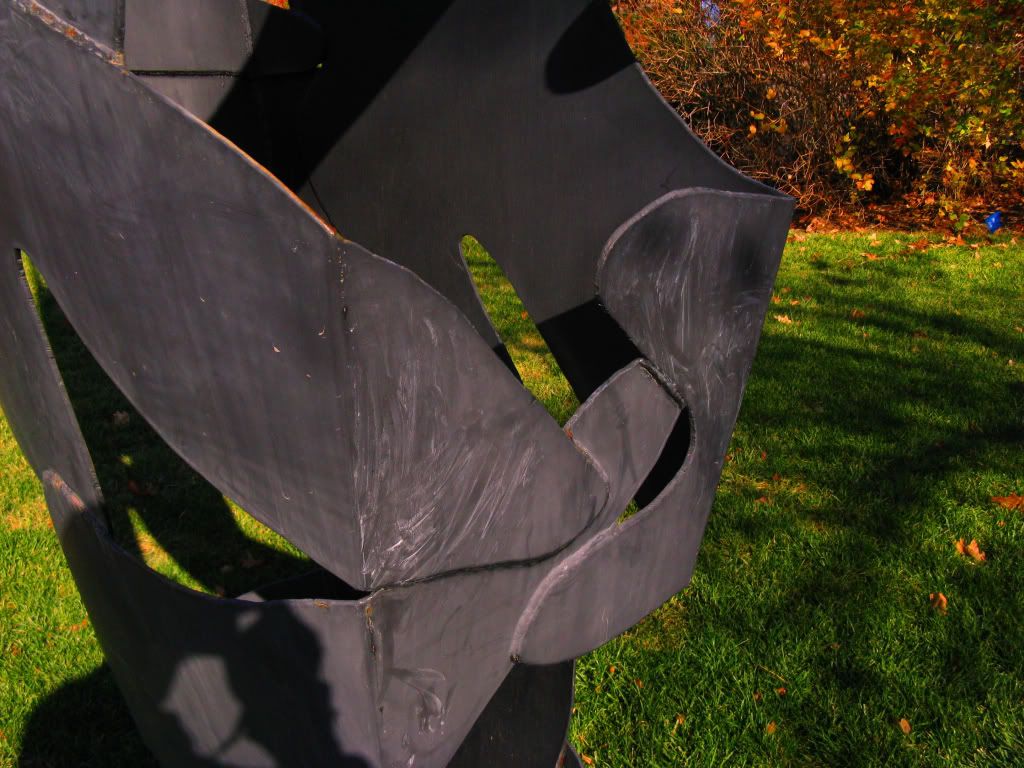
The material that the structure of Arietta II is comprised of is painted black steel. The steel was used to cut out individual abstract bird shapes. These birds were then welded together in an overlapping pattern. The figure is in the shape of a vase so some of the bird’s bodies or wings had to be bent in order to achieve that shape. If you examine the sculpture up close, you can see the exact places where the each bird piece was fused to the other. I think this is an important aspect in the structure of this piece. Although it looks like one unified object from a distance, up close you can still distinguish between each bird. This is a lot like a team. There are individual players, members or co-workers that make up the group, but when it comes to accomplishing tasks it is a team effort. It was windy on the last day I was out studying my art object. If you watched the sculpture closely you could see it swaying slightly from the force of the wind. The vase shape that Arietta II was molded to required that the smaller, partial birds be located at the bottom and support the rest of the pieces as they gradually expand outward towards the top. Therefore, the bottom is less structurally sound and it would be easy for the wind to move it. If the sculpture was instead flipped, becoming a pyramid, I don’t think this would be as likely to occur. This characteristic demonstrates how the sculpture, like a team or group, is only as strong as its weakest element.

The composition of Arietta II is another aspect to consider. Visual hierarchy is evident in this piece of art. Like I mentioned in the paragraph above, the sculpture is constructed in the shape of a vase. The visual hierarchy is controlled by the different sizes of birds used in the composition. The pieces at the bottom are smaller and do not represent a complete bird. It is easily observed that the birds get larger and more complete the closer their location is to the top. When observing this from a distance, it makes it seem like the birds located in the middle to top region are more important because they are more distinguishable. However, if the small partial birds at the base of the sculpture were not present, the sculpture would not have its bottom to top visual hierarchy. The vase shape that the welded birds create takes your eyes from the base to top. Although the smaller pieces may seem unimportant, they are in fact crucial to the composition even though they do not demand much attention from the viewer.

This sculpture is located just north of the Sheldon Art Museum on a small area of grass. There is a variety of buildings that surround the piece of art. The College of Business Administration is directly east of it and Hamilton, the college of arts and sciences, is to the south. Business, arts and sciences are all very different from each other. History is also incorporated into this mix because of the Sheldon Art Museum which is also another whole area of studies. If you walk around the sculpture monitoring the buildings you will notice that they are all different in structure as well. This is reflected in the figure because each bird that Arietta II is made of is different and serves its own individual purpose in the composition of the piece of art. It takes people from all professions to make the world what it is and it is the teamwork of those individuals that makes a difference. Similarly, each bird is needed to make this art object what it is. If one of the birds were missing it would change the structure dramatically, leaving a hole where it once was and disrupting the aesthetic appeal.


A mind blowing example of actual living birds that work together to create a visual masterpiece are the starlings. This youtube video, Starlings on Otmoor, shows how these birds come together every night and create this mass of motion that is absolutely beautiful. At one point in this video the man who is filming says that one of the reasons these birds do this is to protect themselves against predators. I think it shows how extreme this teamwork amongst these starlings really is. This video can be compared to the sculpture Aietta II. Each bird in both of these has a role and a position of importance in the art objects. Without their attribution to the whole composition it would alter the appearance dramatically. It may seem like one bird out of all of the starlings flying in the sky wouldn’t matter, but think about what would happen if two of them would collide. It might spur a reaction that would throw off the whole operation. This can also be said for Arietta II. Catherine Ferguson picked the arrangement of each of the birds on purpose. The whole composition would change if one of the birds were changed to a different position, and possibly this change would make the sculpture less aesthetically appealing.

Teamwork is an important aspect that is put into action every day. Whether you are a team member at the bottom of the structure, mainly serving as support, or a member towards the top, more easily recognized by others for your efforts, each is important. Like the birds in the sculpture, when efforts are put together what can result is often profound and pleasing to the eye. Think about all the championship games that have been won, all the magnificent buildings and skyscrapers that have been built and all the ideas that have been turned into realities. Where would the world be without teamwork? I think it is safe to say it would be a totally different place, and one that I don't think I would care to live in.


Works Cited:

"Arietta." The Free Dictionary . 2009. Farlex Inc, Web. 7 Dec 2009. .

Monday, December 7, 2009

WP3: First Rough Draft

Teamwork is concept I was introduced to at a young age. Whether it was picking up toys with my sisters or playing a round of kickball with the neighborhood kids, some form of teamwork was there. As time went on and I got older, I was faced with new circumstances and challenges, but teamwork was one aspect that remained the same. I was on sports teams, dance team and in different organizations. Each one of these activities required me to work with the other members of my group to reach an end goal. Now that I am in college I still have to use these skills when collaborating efforts for a group project or presentation or at my job. As I was looking at the sculpture, Arietta II, designed by Catherine Ferguson, it continuously reminded me of this idea of teamwork. As I thought about the piece of art and the rhetorical elements that it possesses, I recalled the saying, “You’re only as strong as your weakest player.” Observing this sculpture through an aesthetic point of view, the materials that provide the structure of the sculpture, the visual hierarchy in the composition of its individual parts and its location on UNL City Campus all provide evidence that support the importance of teamwork and this commonly used statement. Along with these key rhetorical elements, the name of the art object also ties in with this argument.

The material that Arietta II is comprised of is painted black steel. The steel was used to cut out individual abstract bird shapes. These birds were then welded together in an overlapping pattern. The figure is in the shape of a vase so some of the bird’s bodies or wings had to be bent in order to achieve that shape. If you examine the sculpture up close, you can see the exact places where the each bird piece was fused to the other. I think this is an important aspect in the structure of this piece. Although it looks like one unified object from a distance, up close you can still distinguish between each bird. This is a lot like a team. There are individual players, members or co-workers that make up the group, but when it comes to accomplishing tasks it is a team effort. It was windy on the last day I was out studying my art object. If you watched the sculpture closely you could see it swaying slightly from the force of the wind. The vase shape that Arietta II was molded to required that the smaller, partial birds be located at the bottom and support the rest of the pieces as they gradually expand outward towards the top. Therefore, the bottom is less structurally sound and it would be easy for the wind to move it. If the sculpture was instead flipped, becoming a pyramid, I don’t think this would be as likely to occur. This characteristic demonstrates how the sculpture, like a team or group, is only as strong as its weakest element.

The composition of Arietta II is another aspect to consider. Visual hierarchy is evident in this piece of art. Like I mentioned in the paragraph above, the sculpture is constructed in the shape of a vase. The visual hierarchy is controlled by the different sizes of birds used in the composition. The pieces at the bottom are smaller and do not represent a complete bird. It is easily observed that the birds get larger and more complete the closer their location is to the top. When observing this from a distance, it makes it seem like the birds located in the middle to top region are more important because they are more distinguishable. However, if the small partial birds at the base of the sculpture were not present, the sculpture would not have its bottom to top visual hierarchy. The vase shape that the welded birds create takes your eyes from the base to top. Although the smaller pieces may seem unimportant, they are in fact crucial to the composition even though they do not demand much attention from the viewer.

This sculpture is located just north of the Sheldon Art Museum on a small area of grass. There is a variety of buildings that surround the piece of art. The College of Business Administration is directly east of it and Hamilton, the college of arts and sciences, is to the south. Business, arts and sciences are all very different from each other. History is also incorporated into this mix because of the Sheldon Art Museum which is also another whole area of studies. If you walk around the sculpture monitoring the buildings you will notice that they are all different in structure as well. This is reflected in the figure because each bird that Arietta II is made of is different and serves its own individual purpose in the composition of the piece of art. It takes people from all professions to make the world what it is and it is the teamwork of those individuals that makes a difference. Similarly, each bird is needed to make this art object what it is. If one of the birds were missing it would change the structure dramatically leaving a hole where it once was and disrupting the aesthetic appeal.

Arietta is an Italian word that means a relatively uncomplicated aria. An aria is an elaborate song for a solo voice (thefreedictionary.com). In other words, an arietta is an uncomplicated song that is meant to be sung by one single person. This may not seem like it has much to do with teamwork, but if you consider what makes up a song it actually does. A song is comprised of different notes. Each note has its role in producing the piece of music. If a note is left out, there could be a break in the song or it could cause problems with the balance or harmony in the musical composition. Like the title suggests, this sculpture could be thought of as its own musical piece. Each bird could symbolize a note. Without one of them, the piece could not be considered whole.

Teamwork is an important aspect that is put into action every day. Whether you are a team member at the bottom of the structure mainly serving as support or a member more easily recognized by others for your efforts, each is important. Like the birds in the sculpture, when efforts are put together, what can result is often profound and pleasing to the eye.


Works Cited:

"Arietta." The Free Dictionary . 2009. Farlex Inc, Web. 7 Dec 2009. .

Friday, December 4, 2009

WP3: Statement of Purpose

The third writing project of this semester requires us to analyze a sculpture in the Sheldon Art Museum Sculpture Garden. This is similar to the two previous writing assignments we have already completed. However, because the piece of art we are examining is a sculpture instead of a picture, there are significant differences that set this writing assignment apart from the others. This changes my requirements I have to fulfill as a writer. My purpose for this third writing project is to present the argument I feel Catherine Ferguson, the creator of Arietta II, intended to express when she designed and built this art object. I will do this by outlining and describing in detail the specific rhetorical elements that my sculpture possesses and how they were used to effectively present the argument.

I will be using the initial observations and inferences I have made during my first pre-write exercise. Some of these rhetorical appeals include: visual hierarchy, abstraction and symbolism. Incorporating these elements into my essay will serve as the evidence to support the argument that I will be presenting. Along with expanding off of my initial inferences, I will be using the information I found while researching for the second pre-write exercise, the portion of the project where we do a historical analysis. I will be looking at how my sculpture and the rhetorical elements it exhibits call your attention to specific parts of the art object, which in turn helps to present the argument at hand. The fact that this art object is three dimensional is another important part of this writing project that was not a factor in the previous two assignments. I will also need to incorporate how this influences and dictates the message and thoughts that my statue provokes.

In this piece of writing I will be viewing my art object through an aesthetic perspective. There are many important elements you can observe while looking at this sculpture. You can also walk around the piece and examine it from multiple angles and views. This is what sets analyzing sculptures apart from analyzing pictures. Not only is this difference important to my argument, but it is also important when considering my audience for this piece of writing. It is important that I have an obvious context where my ideas are coming from in order to establish a strong argument.

In this writing project my audience consists of anyone who reads my blog, specifically though, this mainly includes my classmates and my professor. This writing assignment is graded so I need to consider the guidelines that were posted on the blog by my professor. Although this is an academic piece of writing, it is posted on the internet, therefore anyone can read it. This is also an important aspect to consider. I need to write in a style that can be appreciated by a wide variety of readers. In order to establish ethos through my writing I will need to use a language that my audience can relate to and understand. Another thing to think about in this writing assignment is how the style of Catherine Ferguson’s sculpture can be interpreted in a wide variety of ways because the pieces she uses to construct the sculpture are abstract. This means I will have to present my argument clearly with effective evidence. I will also be able to use multimedia to help explain my argument in ways that words might not be able to communicate. In addition to covering my points in a way that is convincing I also want to leave my audience with something to think about and take away with them after they finish reading. I believe I can compose a successful piece of writing if I am able to complete all the goals I have outlined above.

Monday, November 30, 2009

WP#: Historical Research


My art piece is called Arietta II and was built in 1998. The sculpture was designed by Catherine Ferguson. She is an artist from Omaha, Nebraska. She has a wide variety of work ranging from drawings to sculptures to opera settings. Her work is featured, not only at the Sheldon Art Museum, but also at the University of Nebraska Omaha, the Museum of Nebraska Art, the Landmark Building, the Omaha Public Library and the Qwest Center in Omaha among others. Outside of these public art works she also has some private pieces. According to her biography on her website, her installations usually have a mythical and idealistic quality to them. These pieces are what she is most well known for. In addition to her work as an artist she also serves as a board member for Bemis Center for Contemporary’s Arts and held a board member position for six years on the Nebraska Arts Council (catherineferguson.com).


I looked through pictures of some of her other pieces of art work which can be found on her website. Her drawings were all in black and white and the medium of choice was ink on paper. These drawings consisted of crosshatched lines that depicted one single object or a group of two or three similar objects. The titles of these drawings were simple whatever the name of the object was followed by a number if there was more than one representation of that particular object. Al-Khemia is the title of an installation that is located inside of Sheldon Art Museum.

There was a variety of different sculptures that she featured. Her sculpture was made of painted cast bronze or steel. These sculptures were all what I would classify as abstract. Most of them had some sort of connection with nature and she incorporated stick or twig-like shapes into many of them. All of the public sculptures I viewed incorporated some sort of animal or element from nature. There was also a similar sculpture to Arietta II in the private collection section that was titled Bird Bowl. It appeared to have the same concept, a unified composition of black painted steel birds. I found a quote from the documentary Is It Art? By Joel Geyer from Catherine Ferguson regarding her use of animals in her work that helps to explain why she likes to incorporate them: "By putting the animals in there, I am trying to add an archetypal element to it -- Carl Jung's idea of animals being part of our deepest selves in our dreams, the part that we maybe know the least. Well, as westerners we have a real separation and we have a conflict with nature and are always wanting to be superior to nature and dominate it. I'm more comfortable with a balance with it, but I think it's something we all just have to continue to examine. Way back I think I decided that the farther we get away from nature the more psychotic we're going to be. (netnebraska.org)" I think this quote will help me to see her sculpture Arietta II more in the way she intended when she designed it and I believe this will be important when it comes to writing my third writing project.


Works Cited:

Ferguson, Catherine. "Bio." Catherine Ferguson. 2007. Web. 30 Nov 2009.


Geyer, Joel. "Catherine Ferguson-Installation Artist." State Wide Interactive. 30 Aug 1993. Web. 30 Nov 2009. .

WP#: Third Pre-Write


On Thursday during class I experienced a new form of music composed by Wayne Coyne which he calls Zaireeka. I found it to be extremely interesting and unlike anything I have ever been a part of. It enabled me to see music as more than just what it is and changed my perception of it as well. It introduced me to a whole new way of thinking, one that I feel like I still cannot quite completely grasp on to. The thought of taking one element and joining it with other elements of its kind the way Wayne Coyne did with his 4 individual CD’s is a task that seems a rather mind boggling to me. You would not have thought that the bizarre and diverse sounds, lyrics and melodies that were coming from the four different sets of speakers would blend together to make a single song that is actually pleasing to listen to. However, when the tracks were in unison or at least playing somewhat in the manor they were intended to, the musical composition that resulted was amazing and intriguing. It was almost something that I can’t even put into words. This concept of taking something and considering it for more than what it is can be applied to my sculpture for the third writing assignment.

An initial response towards Arietta II by any random person who passes by might just simply be an attitude of recognition and appreciation for the piece of art. This would be what I would consider to be taking the object for what it is, nothing more, nothing less. This person could identify that the sculpture is indeed made up of individual steel cut-outs of birds welded together to make the shape of a vase. If this were the case, this person could still take a deeper look at the sculpture to realize there is more to it than that. Listening to and experiencing Zaireeka has given me a greater understanding of how to tap into the idea of conceptualizing a sculpture for more than just a sculpture.

I think my sculpture, as an art object, adds to its natural environment that surrounds it in an important way. The sculpture is located outside of Sheldon Art Museum. It is in the center of a pad of grass that is surrounded by a few trees and some bushes. Although a steel sculpture is not something I would normally consider natural, I feel like its location and the fact that it is made up of birds helps the object become part of its natural surroundings. Birds are commonly seen outside and obviously they live in trees. The birds that make up this sculpture are larger than what would normally be seen on city campus. I think this is something interesting to consider and also an intensification of the natural environment that surrounds Arietta II. Without the sculpture there would be nothing that really sets this specific area on campus apart from other areas. The art object creates interest. The shadow of the sculpture is an art object in itself which brings interest into the surrounding environment. It creates movement because of the individual placement of each bird. It provokes thought and question and inspires imagination. I don’t feel like this area would posses these things if the sculpture wasn’t there.

Monday, November 23, 2009

WP3: Second Pre-Write


Some people say change is a good thing, while others think that it is the worst thing in the world. Last Thursday we experienced a change in the classroom that came as a bit of a confusing shock. Instead of our normal routine of receiving instructions from our professor and participating in group discussions led by him, we were given an entire class period of silence. We didn’t get a single word of direction. All we were presented with was a youtube video sequence dealing with John Cage and his piece titled 4’33”. As you could imagine this change in classroom routine sparked a lot of confusion among my classmates and me. We more or less got out of class what we put into it and it was more of a self instructed day of learning. After thinking about Thursday’s class and the third writing project we are currently working on, I found both situations to have some similarities.

This writing project asks us to analyze an assigned sculpture outside of the Sheldon Art Museum. On the first class day we began this assignment we each went to our sculpture and wrote about the rhetorical elements that could be found in it. It wasn’t extremely hard to pick out specific elements, but unlike the previous two assignments, I found it was much harder to form an argument based upon these rhetorical appeals. I realize now that, like our unexpected classroom experience on Thursday, the reason it was more difficult was because we are faced with a change in the form of art we are analyzing. I have gotten used to analyzing a photograph or picture.

It is a whole different situation examining a free-standing, actual three dimensional object instead of an image. When looking at a picture, you are confined to what is within the image. There are no outside elements that influence what is shown. Now that the art object we are analyzing is located outside it changes things drastically. Instead of only taken what is presented by the piece of art itself, you can now take outside influences into consideration. One of these influences is the topography and organic material that surround the sculpture. My piece, Arietta II is located on a downward sloping area of grass that is outlined by trees and bushes. This gives me the opportunity to relate this sculpture to nature. You would not be able to do this in the same way if the sculpture was located indoors. Since my sculpture is a composition of birds, the way I perceive it would be much different if I was viewing the piece from indoors. You think of birds as an animal that belongs outdoors living in nature. The abstract sculpture is more realistic outside where you are used to associating the birds that have created it with. John Cage’s composition, 4’33”, required you to rely on outside sound to compose the actual music that you heard during the piece of music. I think this is an important part to analyzing and forming an argument for sculptures located outside instead of within a building as well. We must look to outside elements for support. It is important to take into consideration the impact these elements have on the piece of art and also the affects our sculpture has on the environment that surrounds it.

Wednesday, November 18, 2009

Pre-Write 2

The name of my sculpture is Arietta II. It was created by Catherine Ferguson in 1998. It is located directly north of the Sheldon Art Museum in front of a small parking lot. The ground slopes downward after the cement of the parking lot ends and the sculpture is placed in the middle of this plot of grass. There are three trees and some evergreen bushes that surround this section of grass which makes it seem like it is surrounded more by nature than buildings. The sculpture is made of painted black steel. There are a series of abstract birds that have been cut out of steel and welded together to produce this sculpture.

No two of the birds that make this piece of art are alike. The birds were bent and shaped to form a pyramid shaped vase. By the way it was constructed, with each individual bird connected to the one above, below and to the side of it, it is hard to determine what the black steel objects are in the sculpture at first glance. You notice more the positive/negative space relationship that the structure has. If you look at Arietta II as a whole, it is not obvious that the shapes that make it up are birds. However, if you look at it for an extended amount of time, you start to pick out each bird.

There are 12 birds that are molded together to make the statue. The birds are all flying upwards like they are coming out of the ground. It almost looks like they are escaping from underground. When you take into consideration the shape that these birds are making by the way they are bent and welded together, instead it looks like they are protecting or holding something inside.

The way Catherine Ferguson has arranged these birds within her composition creates a sort of visual hierarchy. The birds get larger and more distinctly recognizable as birds as you move up through the sculpture. There is also more space between each bird the closer you get to the top. Some of their wings are left free instead of being a connecting element and they point upward towards the sky. All of the birds’ heads also are positioned in an upwards direction. It seems that the sculpture wants your vision to end in the sky which is interesting since you would normally think of birds being free to fly in the sky but instead these birds are stuck frozen in time, yet they look like they have the intent to fly away.

It was hard to pick out a distinguished focal point in this sculpture. I was drawn in particular to a single bird that is located in the upper half of this piece of art. It is on the front or east side of it and it is the most realistic looking out of all the birds. The space left open around it forms a slight frame around its upper half of its body. This may or may not have been an intentional focal point of the her piece of work, but as a viewer I interpreted it this way.

Tuesday, November 17, 2009

Pre-Write 1

There are several experiences that I have had so far in my life that I feel like have given me a little experience with art objects. I don’t think I am an expert by any means, but I do feel like I have some basic knowledge and understanding of them.
I have taken two art history courses in during my college career. Both of these classes have required me to study different sculptures, from classical to more modern. This has provided me with some terminology that is used to describe these works such as high relief, low relief, contrapposto and positive/negative space. I have also been able to listen to my professors explain each of the pieces of art we were required to learn about which will hopefully help me analyze my assigned sculpture.
The second experience I feel lucky to have that has increased my familiarity with art objects is my trip to Europe when I was 16 years old. While sightseeing in Germany, Belgium, Netherlands, England, Scotland and France I was able to observe a wide variety of sculpture and art objects from statues to famous architectural buildings. We went to a number of museums in each country. The Louvre was probably the most amazing place I have ever been. It was incredible to see all the famous works by the influential artists like Michelangelo, Raphael and Leonardo de Vinci. This also gave me a greater appreciation for art that I probably wouldn’t have had at that age. Taking these experiences into account, I still do not have much experience in regards to modern sculpture, like we are analyzing for this third writing project. I had to draw some of the sculptures for my perceptual drawing class that I took earlier this semester so I do have an appreciation towards them from an artist’s point of view but that is about all the farther my experience goes.

Sunday, November 15, 2009

WP 3 Analyzing Comics:

Author's Note:

With a small amount of experience under my belt dealing with the writing we are asked to compose in these writing projects, I assumed this second writing project, analyzing comics, would be much easier than the first one had been. I found that this assumption, for the most part, was true. I was able to write the pre-writing exercises faster than I had the first time. It was also easier for me to reach the minimum word count requirement for these assignments as well as the rough draft. I was able to pick out the argument I thought the comic was making and quickly find the elements within the comic that supported this argument. I think this was because I am now more familiar with the text we use in this class, Compose Design Advocate, and the meanings of the words from the text that I wanted to incorporate into my piece of writing. I also have a better understanding of how to write in a manner that affectively supports an argument after completing an assignment of this type once before. Although I had the luxury of these advantages, I still made many changes to my first draft and faced a few challenges during my writing process.
I made a few changes in my introduction after peer reviews. I added a link giving some background information about Natalie Dee. This provides my readers with more of an idea of what the style of her comics are. I also removed the sentence “There are different types of greetings depending on what part of the world you are in.” I realized after reading through my essay that this sentence is extremely repetitive with the one that fallows it: “People greet each other in various ways from culture to culture for example.” The last change I made to this portion of my writing was to add a sentence at the end of the paragraph outlining the elements I would be discussing in the rest of my essay which reads, “This argument is enforced in this comic through its use of visual hierarchy, abstraction and symbolization of its depicted objects.”
I added the most to the body of my writing project. After receiving feedback on my first drafts I realized I was missing some important components. All of these additions took place at the end of the body. At the end of my fourth paragraph I added the sentence: “This would change the meaning of the comic to instead making you think the dog is possibly missing his lover.” I felt adding this provided a better closing. I also added a section about the structural parallelism between the two hearts in the comic including: “This is reinforced by the relationship between the two hearts in the comic……These two objects play off of each other to help us clearly understand the dog’s intentions.” Finally, I incorporated the Scott McCloud essay into my writing by adding: “It seems to say that just because the picture’s objects are abstract does not mean that they don't make sense….the objects would be more detailed and therefore demand more attention than what they do in the simple illustration.” These last two additions provided more evidence for my argument and helped strengthen my ethos. I also added a picture in the body of my essay of a real dog that the abstract dog could have resembled. I did this to show the contrast between the comic and a real picture.
The only change I made in my conclusion was removing the adjective loyal from the sentence: “interesting Valentine that the loyal dog is giving his owner…” Loyalty was not discussed anywhere else in the essay therefore it wasn’t the best idea to bring it into the conclusion.
I made a few general changes such as grammatical errors that I found scattered throughout my essay, as well as some misspellings. I also found myself using the word picture instead of comic in my writing. This was probably what was most challenging. I had to get myself in a slightly different mindset since the genre of writing was different this time around. I went from discussing a photograph, which is a real depiction, to providing evidence about a comic, something that is not. However, I think I was able to overcome this and compose a successful essay.


First Rough Draft
Second Rough Draft
Statement of Purpose

Final Draft:

Today’s society is filled with “rules” and “expectations” that seem to govern the way we act. These regulations are known as social norms. You can observe them in action any time you are somewhere public. If you think about it, almost everything you do during a day can be related to what is acceptable behavior for the certain task you are carrying out. For example, on a normal school day you wouldn’t see someone wearing formal attire to a class. At an important event, however, this would be acceptable. When you are attending a movie in theatres you don’t sit and talk to the person you came with the whole time. You could do this at a restaurant though. Social norms depend on the culture you live in. Different kinds of behavior are accepted in different parts of the world. People greet each other in various ways from culture to culture for example. The comic Valentine From the Dog by Natalie Dee makes an interesting point in regards to social norms and how people show affection. When we look at this as humans, we don’t see it as what we would normally think of a valentine consisting of. An excretion of waste is not what our culture accepts as a way to show your feelings of affection towards another. To this dog on the other hand, it was meant as a gesture to show his love for his owner. This demonstrates how different behavior and customs can be viewed differently depending on the culture you are associated with. This argument is enforced in this comic through its use of visual hierarchy, abstraction and symbolization of its depicted objects.

There is a clear visual hierarchy in this comic that helps to shape this argument. The first thing you notice in the picture is the dog’s eyes. These eyes are not realistic at all, instead they are abstract. They are wide, round circles that are looking straight at you, the comic viewer, with almost laser-like intentions. This makes it quite obvious that the viewer is intended as the vector of attention in this comic. You are depicted as this dog’s owner. This is significant because it reveals that the valentine has been left for you and not another person or animal.

The second part in the comic that your eye is drawn to is the pink heart that is above the dog’s head. It appears that this heart is used to symbolize what the dog is thinking. A heart is widely accepted to resemble love or affection. I think that is exactly what it is intended to represent in this comic. The dog has given what he thinks to be a perfect gift to his master as a way to show his feelings towards him or her, depending on the viewer.

The first object, the dog’s eyes, and the second object, the heart above the dog’s head both begin to communicate what the comic is trying to say. The eyes have established the vector of attention, you, and the heart now tells you how the dog feels towards the vector of attention. If this heart wasn’t there to symbolize this relationship, you might get a totally different impression of this comic. The dog’s wide eyes can lead you to think in many different directions. It may seem instead like the dog is worried about what his owner is going to think about the mess he or she has left a little ways behind. It could also appear that the dog is almost surprised or alarmed at what he has done. This would make sense considering you don’t commonly come across a piece of dog poop that is heart shaped. So it is apparent that the heart above the dog’s head serves as a very important piece of information in this picture.

Finally, the item that is last in the line of visual hierarchy, the waste left behind by the dog. There is also symbolism that is apparent with this second heart shaped object. The piece of poo is meant to resemble the valentine. Like the dog’s eyes, it is slightly abstract. Many times homemade valentines are cut in the shape of hearts. Chocolates are sold in heart shaped boxes around Valentine’s Day. The heart is the shape that is commonly known to be associated with Valentine’s Day. This enforces that the poop is not ordinary, but instead intended as a gift for the occasion of Valentine’s Day. Like the pink heart above the dog’s head, the picture would be perceived differently if it was either not pictured, or not heart shaped. Without it, there would be aspects about the pictures that remain unclear. Why is the dog thinking about, showing or feeling love? It looks like the dog may be feeling lost if you just look at it and the heart, cropping out the right side of the picture. This would change the meaning of the comic to instead making you think the dog is possibly missing his lover.

When all three objects in the scale of hierarchy are put together they form a complete narration to the comic. You already know that the dog is showing affection towards the vector of attention, you, and when you add in the last object it is clear how the dog is showing his affection. He is giving his owner a Valentine. This is reinforced by the relationship between the two hearts in the comic. The shape of the pink heart above the dog’s head is similar to the shape that the dog has left with his excrement. These two hearts balance eachother out. This structural parallelism is important because it shows that his droppings were left as a sign of love. These two objects play off of each other to help us clearly understand the dog’s intentions. It is important to the comic that these three objects have a strong and clear relationship because there are no words to help us understand what is going on in the picture. We must rely on what the objects mean and how they play off on another to establish the intended idea of the comic.

The fact that this comic is abstract is another aspect to consider. Abstract can be defined as not applied or practical. (thefreedictionalry.com) A piece of poop is not exactly thought of as a gift that applies or is practical for someone on Valentine’s Day. However, in this instance it is. A dog cannot make anything or buy a gift like a human can, therefore, this gift can be defined as practical. The way all the objects in the picture are drawn abstractly serves to support this. It seems to say that just because the picture’s objects are abstract does not mean they don't make sense. In fact, this level of abstraction serves beneficial to the comic and the argument that is being outlined. Chapter 11 of the The Scott McCloud Essay discusses how abstraction in comics can focus your attention on specific deatails in the illustrations. The three objects, the dog's eyes, the heart and the feces, are the only objects that the viewer directs their attention to. If this comic was instead a photograph taken with a camera, it would not have the same affect because the objects would be more detailed and therefore, demand more attention than what they do in the simple illustration.

I think this comic asks us to think about what we consider to be socially acceptable in the places that we live in today. We may look at something as unacceptable or weird when, in some cultures, it is considered normal. Like the interesting Valentine the dog is giving his owner, we may not be looking at what we're seeing through their culture’s point of view. Sometimes if we stop and think, we realize that there is more to something than what first meets the eye and maybe what we find to be unusual is actually quite normal.

Works Cited

"Abstract." The Free Dictionary . 2009. Farlex, Web. 8 Nov 2009. .

Wednesday, November 11, 2009

WP 2 Second Rough Draft:

Today’s society is filled with “rules” and “expectations” that seem to govern the way we act. These regulations are known as social norms. You can observe them in action any time that you are somewhere public. If you think about it, almost everything you do during a day can be related to what is acceptable behavior for that certain task you are carrying out. For example, on a normal school day you wouldn’t see someone wearing formal attire to a class. At an important event, however, this would be acceptable. When you are attending a movie in theatres you don’t sit and talk to the person you came with the whole time. You could do this at a restaurant though. Social norms depend on the culture you live in. Different kinds of behavior are accepted in different parts of the world. There are different types of greetings depending on what part of the world you are in. People greet each other in various ways from culture to culture for example. The comic Valentine From the Dog by Natalie Dee makes an interesting point in regards to social norms and how people show affection. When we look at this as humans, we don’t see it as what we would normally think of a valentine consisting of. An excretion of waste is not what our culture accepts as a way to show your feelings of affection towards another. To this dog on the other hand, it was meant as a gesture to show his love for his owner. This demonstrates how different behavior and customs can be viewed differently depending on the culture you are associated with. This argument is enforced in this comic through its use of visual hierarchy, abstraction and symnolization of its depicted objects.

There is a clear visual hierarchy in this picture that helps to shape this argument. The first thing you notice in the picture is the dog’s eyes. These eyes are not realistic at all, instead they are abstract. They are wide, round circles that are looking straight at you, the comic viewer, with almost laser-like intentions. This makes it quite obvious that the viewer is intended as the vector of attention in this comic. You are depicted as this dog’s owner. This is significant because it reveals that the valentine has been left for you and not another person or animal.

The second part in the picture that your eye is drawn to is the pink heart that is above the dog’s head. It appears that this heart is used to symbolize what the dog is thinking. A heart is widely accepted to resemble love or affection. I think that is exactly what it is intended to represent in this comic. The dog has given what he thinks to be a perfect gift to his master as a way to show his feelings towards him or her (depending on the viewer).

The first object, the dog’s eyes, and the second object, the heart above the dog’s head both begin to communicate what the comic is trying to say. The eyes have established the vector of attention, you, and the heart now tells you how the dog feels towards the vector of attention. If this heart wasn’t there to symbolize this relationship, you might get a totally different impression of this comic. The dog’s wide eyes can lead you to think in many different directions. It may seem instead like the dog is worried about what his owner is going to think about the mess he or she has left a little ways behind. It could also appear that the dog is almost surprised or alarmed at what he has done. This would make sense considering you don’t commonly come across a piece of dog poop that is heart shaped. So it is apparent that the heart above the dog’s head serves as a very important piece of information in this picture.

Finally, the item that is last in the line of visual hierarchy, the waste left behind by the dog. There is also symbolism that is apparent with this second heart shaped object. The piece of poo is meant to resemble the valentine. Like the dog’s eyes, it is slightly abstract. Many times homemade valentines are cut in the shape of hearts. Chocolates are sold in heart shaped boxes around Valentine’s Day. The heart is the shape that is commonly known to be associated with Valentine’s Day. This enforces that the poop is not ordinary, but instead intended as a gift for the occasion of Valentine’s Day. Like the pink heart above the dog’s head, the picture would be perceived differently if it was either not pictured, or not heart shaped. Without it, there would aspects about the pictures that remain unclear. Why is the dog thinking about, showing or feeling love? It looks like the dog may be feeling lost if you just look at it and the heart, cropping out the right side of the picture.

When all three objects in the scale of hierarchy are put together they form a complete narration to the comic. You already know that the dog is showing affection towards the vector of attention, you, and when you add in the last object it is clear how the dog is showing his affection. He is giving his owner a Valentine. It is important to the comic that these three objects have a strong and clear relationship because there are no words to help us understand what is going on in the picture. We must rely on what the objects mean and how they play off on another to establish the intended idea of the comic.

The fact that this comic is abstract is another aspect to consider. Abstract can be defined as not applied or practical. (thefreedictionalry.com) A piece of poop is not exactly thought of as a gift that applies or is practical for someone on Valentine’s Day. However, in this instance it is. A dog cannot make anything or buy a gift like a human can, therefore, this gift can be defined as practical. The way all the objects in the picture are drawn abstractly serves to support this. It seems to say that just because the picture’s objects are abstract does not mean that they don't make sense. In fact, this level of abstraction serves beneficial to the comic and the argument that is being outlined. Chapter 11 of the The Scott McCloud Essay discusses how abstraction in comics can focus your attention on specific deatails in the illustrations. The three objects, the dog's eyes, the heart and the feces, are the only objects that the viewer directs their attention to. If this comic was instead a photograph taken with a camera, it would not have the same affect because the objects would be more detailed and therefore demand more attention than what they do in the simple illustration.

I think this comic asks us to think about what we consider to be socially acceptable in the places that we live in today. We may look at something we see as unacceptable or weird when, in some cultures it is considered normal. Like the interesting Valentine that the loyal dog is giving his owner, we may not be looking at what we are seeing through their culture’s point of view. Sometimes if we stop and think, we realize that there is more to something than what first meets the eye and maybe what we find to be unusual is actually quite normal.

Works Cited

"Abstract." The Free Dictionary . 2009. Farlex, Web. 8 Nov 2009. .

Monday, November 9, 2009

WP2 First Draft:

Today’s society is filled with “rules” and “expectations” that seem to govern the way we act. These regulations are known as social norms. You can observe them in action any time that you are somewhere public. If you think about it, almost everything you do during a day can be related to what is acceptable behavior for that certain task you are carrying out. For example, on a normal school day you wouldn’t see someone wearing formal attire to a class. At an important event, however, this would be acceptable. When you are attending a movie in theatres you don’t sit and talk to the person you came with the whole time. You could do this at a restaurant though. Social norms depend on the culture you live in. Different kinds of behavior are accepted in different parts of the world. There are different types of greetings depending on what part of the world you are in. People greet each other in various ways from culture to culture for example. The comic Valentine From the Dog by Natalie Dee makes an interesting point in regards to social norms and how people show affection. When we look at this as humans, we don’t see it as what we would normally think of a valentine consisting of. An excretion of waste is not what our culture accepts as a way to show your feelings of affection towards another. To this dog on the other hand, it was meant as a gesture to show his love for his owner. This demonstrates how different behavior and customs can be viewed differently depending on the culture you are associated with.

There is a clear visual hierarchy in this picture that helps to shape this argument. The first thing you notice in the picture is the dog’s eyes. These eyes are not realistic at all, instead they are abstract. They are wide, round circles that are looking straight at you, the comic viewer, with almost laser-like intentions. This makes it quite obvious that the viewer is intended as the vector of attention in this comic. You are depicted as this dog’s owner. This is significant because it reveals that the valentine has been left for you and not another person or animal.

The second part in the picture that your eye is drawn to is the pink heart that is above the dog’s head. It appears that this heart is used to symbolize what the dog is thinking. A heart is widely accepted to resemble love or affection. I think that is exactly what it is intended to represent in this comic. The dog has given what he thinks to be a perfect gift to his master as a way to show his feelings towards him or her (depending on the viewer).

The first object, the dog’s eyes, and the second object, the heart above the dog’s head both begin to communicate what the comic is trying to say. The eyes have established the vector of attention, you, and the heart now tells you how the dog feels towards the vector of attention. If this heart wasn’t there to symbolize this relationship, you might get a totally different impression of this comic. The dog’s wide eyes can lead you to think in many different directions. It may seem instead like the dog is worried about what his owner is going to think about the mess he or she has left a little ways behind. It could also appear that the dog is almost surprised or alarmed at what he has done. This would make sense considering you don’t commonly come across a piece of dog poop that is heart shaped. So it is apparent that the heart above the dog’s head serves as a very important piece of information in this picture.

Finally, the item that is last in the line of visual hierarchy, the waste left behind by the dog. There is also symbolism that is apparent with this second heart shaped object. The piece of poo is meant to resemble the valentine. Like the dog’s eyes, it is slightly abstract. Many times homemade valentines are cut in the shape of hearts. Chocolates are sold in heart shaped boxes around Valentine’s Day. The heart is the shape that is commonly known to be associated with Valentine’s Day. This enforces that the poop is not ordinary, but instead intended as a gift for the occasion of Valentine’s Day. Like the pink heart above the dog’s head, the picture would be perceived differently if it was either not pictured, or not heart shaped. Without it, there would aspects about the pictures that remain unclear. Why is the dog thinking about, showing or feeling love? It looks like the dog may be feeling lost if you just look at it and the heart, cropping out the right side of the picture.

When all three objects in the scale of hierarchy are put together they form a complete narration to the comic. You already know that the dog is showing affection towards the vector of attention, you, and when you add in the last object it is clear how the dog is showing his affection. He is giving his owner a Valentine. It is important to the comic that these three objects have a strong and clear relationship because there are no words to help us understand what is going on in the picture. We must rely on what the objects mean and how they play off on another to establish the intended idea of the comic.

The fact that this comic is abstract is another aspect to consider. Abstract can be defined as not applied or practical. (thefreedictionalry.com) A piece of poop is not exactly thought of as a gift that applies or is practical for someone on Valentine’s Day. However, in this instance it is. A dog cannot make anything or buy a gift like a human can, therefore, this gift can be defined as practical. The way all the objects in the picture are drawn abstractly serves to support this. It seems to say that just because the picture’s objects are not completely realistic does not mean that doesn’t make sense.

I think this comic asks us to think about what we consider to be socially acceptable in the places that we live in today. We may look at something we see as unacceptable or weird when, in some cultures it is considered normal. Like the interesting Valentine that the loyal dog is giving his owner, we may not be looking at what we are seeing through their culture’s point of view. Sometimes if we stop and think, we realize that there is more to something than what first meets the eye and maybe what we find to be unusual is actually quite normal.

Monday, November 2, 2009

WP2 Exercise 2:

The comic I have chosen is by a woman named Natalie Dee. This is also the title of the comic that she writes and illustrates. She is 30 years old and lives in Columbus Ohio. She is also the co-author to Married to the Sea, a comic she writes with her husband that is also posted via the internet. There are over 1500 comics that she has composed on the Natalie Dee website. These comics date back all the way to year 2003. They are all illustrated in the same manor, stick like figures and text in the form of hand written letters. They are all relatively simple drawings that depict one or two characters. These characters are either humans or different random animals. She also has a few that feature non-living objects that are given human characteristics. Most of the pictures require you to rely on your imagination and past experience to either make your own assumptions of what the character or characters are thinking, especially the drawings that do not have any text to go along with them. Most of them, however, do have at least some sort of caption to go along with them that serves to narrate the picture. All of her comics that I have looked at have been one picture. There were no comics that I observed on her web site that consisted of multiple frames.

I did some investigating to find out what the exact date was that this comic was posted. In was in the section for the month of February. I counted up from the bottom of the page and it appears that this was the selected comic for the date around February 12th 2009. The comic from the day before and the day after (approximately sometime between the 11th and 14th) also both have subjects that are based around love. Valentine’s Day is February 14th so it is obvious why this was the subject for her comics at this time of the year.

I think it is interesting that she featured the comic with the dog for a date that was before February, 14th. After taking a look at the comic and thinking about what the possible arguments of the illustration could be, it seems very logical for her to choose to display this comic on the day that she did. It appears that this dog is alone and possibly missing his or her significant other. Maybe they are no longer seeing each other or perhaps this other dog is just simply on his or her mind because they cannot be together and the dog in the picture is missing its company. Either way, I think this comic does a good job showing the feelings some people have around Valentine’s Day when they are single or without their significant other. Like the emotions expressed on the dogs face, Valentine’s Day can be sad or depressing in some cases when you do not have anyone to share it with. This was a good way for Natalie Dee to relate to her audience. Also, the object left behind by the lonely dog probably provided some humor to cheer the lonely people out there this past Valentine’s Day.

WP2 Exercise 1:


In this illustration by Natalie Dee, she depicts a dog with a heart above its head. The dog’s facial expression seems to make him look rather lost, sad or confused. In the background you can see that the dog has recently gone to the bathroom. Instead of a normal looking piece of waste, this dog has pooped in the shape of what appears to be a heart.


The dog seems to be the main focus of the cartoon because it is closer in the line of view and takes up the most space out of all three objects that are depicted. It is also the object that has the most detail. Although it is by no means a perfect picture of a dog, it gives enough evidence to be a convincing depiction. Natalie Dee uses black outlines and two different colors of brown to outline the shape of the dog’s face. In the darker brown color the dog has two ears which further develop the head as one that would belong to a dog. She also draws a blue band with a gold circle attached to it which you can recognize as a collar, something a typical domestic dog would wear.


The dog’s facial expression is something that I think is an important part of this picture. His eyes are wide and perfectly round. There are many emotions that you can associate with this for example, surprise, horror or maybe being possessed. If you move down to his mouth, it is slightly opened and his bottom teeth are showing. This can be associated with emotions involving the drop of the jaw like confusion, sorrow or perhaps disbelief. To me, this dog looks like he or she needs help, almost like it is looking for an answer.
There is a pink heart located right above the dog’s head. Hearts are usually associated with love so this could be some sort of symbol in this illustration. There is a short line between the top of its head and the bottom of the heart which makes it look like the dog and the heart are connected. This could mean that the dog is thinking about love or maybe it is a status marker, he is in love or someone else has his or her heart.


The last object in the picture is the piece of poop left behind by the dog. It appears as though the dog did his business and has now walked closer to the viewer where he is pictured. The interesting thing about it is that it is also heart shaped. This brings about the question of why Natalie Dee depicted it this way.


The dog, heart and heart-shaped poo all work together to make a scene that could almost tell a story within itself. When you take into consideration his facial expression along with the heart, you realize some form of love or relationship is on the dog’s mind, but when you see this shape repeated in the background, it enforces this theme ever farther.

Statement of Purpose:

My purpose as a writer for the second writing project of this semester is to analyze the comic I have chosen. In doing this I need to distinguish an argument that the author of this comic, Natalie Dee, could have been trying to make. I will need to present this argument by describing in detail the specific elements of the comic and how they were used to achieve the argument. I also need to address ethos, logos and pathos and how these elements I will be outlining were used to develop these key components in writing. In order to do this I will be expanding off of my initial inferences I have already made during the first writing exercise. I will also incorporate what I discovered in the second writing exercise where I completed a historical analysis of my comic. I will be looking at how the comic uses icons and symbols to make the viewer focus on specific parts in the picture and how the comic is understood a certain way because of our human knowledge. I will also relate this comic and its elements to the time we are living in as a society.

I will be viewing this comic through a cultural perspective. This is an important part in my essay. Analyzing this comic while considering today’s society and the social norms that go along with it during and around the holiday of Valentine’s Day will be crucial to my essay. There are many connections you can make when viewing the picture and keeping these norms in mind. Incorporating this into my essay will establish a clear context for my readers to think about while reading my piece of writing. In turn, I will be able to outline a believable argument that can be easily understood by my audience.

In this writing project my audience consists of anyone who reads my blog, specifically though, this mainly includes my classmates and my professor. This writing assignment is graded so I need to consider the guidelines that were posted on the blog by my professor. Although this is an academic piece of writing, it is posted on the internet, therefore anyone can read it. This is also an important aspect to consider. I need to write in a style that can be appreciated by a wide variety of readers. In order to establish ethos through my writing I will need to use a language that my audience can relate to and understand. Another thing to think about in this writing assignment is how the style of Natalie Dee’s comics can be interpreted in a wide variety of ways because the illustrations she depicts are slightly abstract. This means I will have to present my argument clearly with effective evidence. I will also be able to use multimedia to help explain my argument in ways that words might not be able to communicate. In addition to covering my points in a way that is convincing I also want to leave my audience with something to think about and take away with them after they finish reading. I believe I can compose a successful piece of writing if I am able to complete all the goals I have outlined above.

Thursday, October 15, 2009

Blog # 14: WP1 Final Draft

Authors Note:

This writing assignment was challenging for me in many ways. I have never written a piece dealing with photography, or analyzed a work of any sort and then incorporated it into an essay for that matter. It is also my first time using or thinking about writing in a rhetorical manor. I was rather slow at first when I was trying to write my pre-writing exercises dealing with my chosen picture. After each class meeting time, I became faster at picking out elements in photographs and thinking about them in ways that could be used as evidence to form some sort of an argument. The readings from our textbook, Compose Design Advocate, also gave me greater understanding of the technical elements that are used in photography. I also found that my peers were able to help me as well. By listening to their ideas during group discussions, I was able to expand on the way I look at and analyze pictures. I realized as time went on that I became faster and more in depth in the way I was thinking about the technical aspects of the different pictures and what they might be trying to communicate with the viewer. I was also able to look at my chosen photograph in new ways as well as develop evidence for my argument in a more specific fashion. Each writing exercise done inside of the class room and outside of the classroom at home helped me gather all the elements I needed to develop the final blog post for this first writing project.
The argument I chose to present was different than what I thought I was going to argue initially. I was going to focus more on the interaction between the two people shown in the picture. My two pre-writing exercise posts both reflect that. When we were analyzing each other’s pictures in class one of my classmates brought up how the brightness of the photograph and the expressions on the two people’s faces makes the whole picture seem happy. I thought using that and viewing the photograph through a historical context would form a better argument with a strong connection with the context. The argument I thought the photograph could have been making was: Attitudes among people in the changed in the 1940s when WWII brought the U.S. out of the Great Depression.
I didn’t make too many drastic changes in my essay from the first draft I wrote. I changed some wording in my introduction and added in text citations to make some of my historical statements seem more factual instead of just something I came up with myself. I also added a sentence outlining the technical elements I would be talking about in the body. I added in sentences in my section dealing with body language, specifically about how the man and the woman are interacting. In my paragraph about the building I changed resemble to symbolize when I was talking about the building in order to use text from the book. I put in text citations in my body as well in order to develop ethos.
Overall I am happy with the way my final blog post turned out. I learned a lot through this writing project that I think will strengthen my writing for other papers and essays as well.

Final Draft:

The 1930s marked a decade of disparity and hopelessness in the United States. America was going through the Great Depression. The stock market had crashed and the economy was suffering severely. Jobs were scarce and it was hard for people to even get the essential things they needed to survive (McElvaine). Needless to say, I’m sure the mood throughout the whole country was somber. The government was doing what they could to solve the problem. Even though some reforms, like the New Deal, seemed to be promising, nothing proved to be as successful of a solution as WWII would be. World War II was the event that initially brought the United States out of this deep economic slump. Although America was not officially involved in the actual fighting that was going on in Europe, the supplies needed by the warring countries were manufactured by industries in the United States. This created a large amount of jobs, thus stimulating the economy and pulling the U.S. out of the Great Depression (McElvaine). The atmosphere throughout the country probably did a complete change to optimistic and hopeful. I think the photograph A soldier and a woman in a park, with the Old [Russell] Senate Office Building behind them, Washington, D.C. (LOC) demonstrates this change in attitude among people living in the United States during the early 1940s. There are key technical elements that help support this argumenmt such as, lighting, hue, brightness and vectors of attention. This picture was taken in 1943 by photographers who were working for the government. The Farm Security Administration, later known as the Office of War Information, was documenting life in the United States between 1939 and 1944. They then made these images into transparencies. The individual photographer’s name was not included with the information about the picture. The location is Washington D.C. The identity of the woman and the soldier were not given. The white building in the background is the Old Russel Senate Building located northeast of the Capitol Building . WWII began September 3, 1939 when Germany invaded Poland. By 1943 when this photograph was taken the United States had already officially entered the war on December 8, 1941 after Japan attacked Pearl Harbor (history.navy.mil).

There are several technical elements incorporated into this photograph that help support the argument that people in the 1940s were in much higher spirits than in the 1930s. Lighting, hue and contrast are three photographical elements that can be considered while looking at this photo. This picture was taken using only natural lighting from the sun. This gives the picture a high amount of brightness and makes the image more crisp and realistic. The hues in this photograph are strong. There are not very many colors in the photograph but each one is its own very distinguishable hue. The sky is a light blue, the building is a bright white and the pavement and concrete are also a light gray hue that seems to reflect the natural light from the sun. The dark hues in the picture are found in the trees, bushes and the clothing worn by the two people. However this creates a nice contrast between the lighter colors. These elements start to develop pathos. The combination of brightness, hue and contrast gives the picture a cheery and warm feeling. It is not depressing in the least to look at. It makes you want to enjoy your surroundings, the outdoors and just simply life itself.

The second technical element that helps develop the argument further is the vectors of attention in the picture. There are two main subjects in the photograph, the two people and the Old Senate Building. Even though they are located off the left side of the photograph, I think the main vector of attention out of the two is the woman and the soldier. The woman is sitting facing the photographer. She is sitting very poised professional and polite with her right leg tucked begind her left calf. Her body language seems relaxed by the way her arms are laying in her lap. She has a smile on her face and seems to be enjoying her time just sitting. There does not seem to be any emotion of worry or displeasure. The soldier looks to be as equally relaxed and carefree. He is sitting on the ledge with one knee propped up and his elbow resting on it. He is also almost a little slouched in regards to posture. This is a very casual pose which agrees with the worry free mood this photograph could be portraying. His attention is not directed toward the photographer, but instead he is looking at the woman. He is also smiling and appearing to be enjoying himself. I think the way these two are interacting within the photo also reflects upon the kind of mood the country was in during the 1940s. He is most definitely looking at her, yet she is appearing to be ignoring him to some degree. However, I think she is well aware that he is looking at her by the facial expression she holds. They almost seem playful with one another because of the way he is somewhat opening his body towds her, yet she is faced away from him. The 1930s were, for the most part, serious because of the Great Depression. During the 1940s when the economy started to flourish again people were probably ready to have some fun and enjoy not having to constantly worry.

The second vector of attention, the Old Russel Senate Building, is also something that can be incorporated into the argument of the change to more positive attitudes during the 1940s. This building is a government building that holds the offices of the United States’ senators. To me, including this building in the picture is symbolizing the government. During the 1930s the government was battling a suffering economy. In my opinion, during times of struggle, like citizens of America were facing during the Great Depression, governments and governmental leaders can be blamed for the hardships individuals are facing. Herbert Hoover was in office during the beginning of the Great Depression. He lost support during the early 1930s and was not re-elected. Instead Franklin Delano Roosevelt was elected in 1932 and remained in office until his death in 1945. He is given credit for starting to reverse the struggling economy by issuing his policies like the New Deal and the Second New Deal (fdrheritage.org). This fits into the argument because the people’s attitudes towards the government began to change during and after the Great Depression. When people have a government they can trust and believe in I think they are more likely to be happy and more relaxed. I think this reflects in the woman and the soldier’s facial expressions and body language.

The 1940’s marked a decade of change. The United States was a completely different place than it had been in the 1930s. Everything was different, from the way people dressed to the jobs they had. World War II had a significant amount of influence in this change that swept the nation. A soldier and a woman in a park, with the Old [Russell] Senate Office Building behind them, Washington, D.C. (LOC) communicates through a few simple elements of photography how these changes affected the people living in the United States during this time. In general I think this picture shows how people were simply happier during the 1940s. Although the United States was involved in a world war overseas, there was promise in the day to come, people had jobs and something to look forward to. It was a time of change, but this change was obviously for the better in the eyes of American citizens.


Works Cited:


"Franklin D Roosevelt." American Heritage Center Museum. 2007. Franklin D. Roosevelt American Heritage Center, Inc., Web. 11 Oct 2009. .


McElvaine, Robert S. "Great Depression in the United States." Microsoft® Encarta® Online Encyclopedia . 1997-2009 Microsoft Corporation, 2009. Web.http://encarta.msn.com/encyclopedia_761584403/Great_Depression_in_the_United_States.html.


"Pearl Harbor Raid, 7 December 1941." Naval History and Heritage Command . 16 April 2009. Naval Historical Center, Web. 11 Oct 2009.


Links:

Statement of Purpose

WP1 Rough Draft 1

WP1 Rough Draft 2